繁
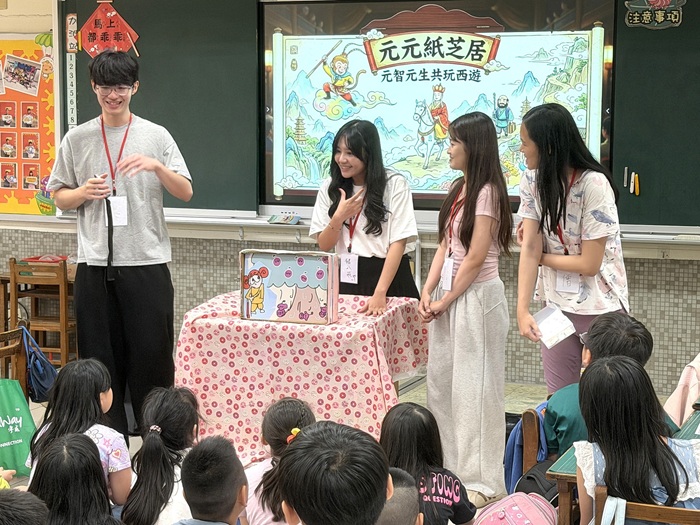
繁 A cross-age collaborative learning activity titled “Yuan-Yuan Kamishibai,” jointly organized by Yuan Ze University and Taoyuan Municipal Yuansheng Elementary School, entered its second year. Through collaboration between the General Education Center at Yuan Ze University and the library of Yuansheng Elementary School, the event featured a storytelling performance themed “Exploring Journey to the West Together.” By integrating the art of kamishibai, multilingual teaching, and cross-age interaction, the event created a lively atmosphere filled with laughter among students of different ages.
The general education course “Chinese Reading, Critical Thinking, and Expression” at Yuan Ze University aimed to cultivate students’ narrative and communication skills, encouraging the use of multimedia and creative performances to enhance both expression and critical thinking. Under the guidance of Wei-Jen Chen, students from the Department of Nursing, the Department of Electrical Engineering, and the College of Management—totaling 40 participants—visited Yuansheng Elementary School to perform kamishibai stories based on Journey to the West for third-grade students.
Kamishibai, which originated in Japan during the Taisho period, is a traditional storytelling art form that combines illustrated cards, a wooden frame, and oral narration. Performers created an animation-like storytelling experience through vivid narration, props, and sound effects, capturing the attention of young audiences. Chen explained that Yuan Ze students selected nine highlights from Journey to the West, created their own illustrations, and designed original kamishibai performances. The first round of performances was presented to a “junior jury panel” composed of two classes of elementary students. Sixty students were divided into nine groups and used evaluation sheets to assess performances based on facial expression, vocal delivery, prop design, and narrative flow. Shih-Han Li, a teacher responsible for reading promotion at the school library, had previously guided the students on how to appreciate and evaluate performances. Awards, including a championship and jury prizes, were presented, and the event was met with enthusiastic applause and cheers.
Wei-Jen Chen also brought professional kamishibai equipment from Japan and personally performed the story “The Little Ninja Marumaru,” allowing participants to experience the children’s focused engagement firsthand. He noted that with the growing number of international students at Yuan Ze University and the increasing diversity of communities in Taoyuan, multilingual environments would become more common in daily life. Therefore, he encouraged students to incorporate language-learning elements into their performances.
Among the performers, a Vietnamese student from the College of Management, Thi-Tam Le, appeared in traditional Vietnamese attire, áo dài, and incorporated Vietnamese language teaching about marine life into the “Dragon Palace” story, which elicited enthusiastic responses from the children. Chen and Japanese students also integrated simple Japanese vocabulary into the storytelling, enabling children to experience multiple cultures and languages while enjoying the stories.
Shu-Chin Tsai, a student from the Department of Information Communication, shared that participating in the kamishibai activity with elementary school students led her to reflect on the relationship between learning and expression. She noted that the children’s confidence and natural engagement in storytelling served as a reminder that learning was not only about understanding the world, but also about developing the courage to express oneself and communicate sincerely—an invaluable experience in her academic journey. A student from Yuansheng Elementary School, Chia-An Hsu, shared, “I learned how to say some Japanese words and heard many exciting stories about Sun Wukong. It was one of the most wonderful memories of my elementary school years.”
The University noted that the “Yuan-Yuan Kamishibai” program had gradually become a signature annual event for both institutions. Through resource sharing and cross-age collaborative learning, it not only enhanced students’ expressive abilities but also fostered positive interactions between campuses, allowing education to extend beyond the classroom and return to genuine interpersonal engagement.