繁
繁 With the arrival of summer vacation, the Department of Foreign Languages and Applied Linguistics, Yuan Ze University, organized the International Cuisine English Camp and the Japanese Cuisine and Language Camp, attracting nearly 60 high school students to campus during their break. Combining English and Japanese language learning with international culinary experiences, the camps featured hands-on cooking activities, cultural introductions, interactive challenges, and cross-cultural exchanges. Through tasting and preparing authentic dishes, students learned languages while gaining a deeper appreciation of the unique cultural characteristics of different countries, making for an enriching and memorable start to their summer vacation.
The International Cuisine English Camp was led by graduate students from Spain and Indonesia in the Department of Foreign Languages and Applied Linguistics. Using English as the medium of instruction, they introduced representative dishes from their home countries, including Spanish tacos and Indonesian nasi lemak. The sessions covered the historical background, culinary traditions, and distinctive ingredients of each dish. Students then selected toppings such as tomatoes and cheese according to their preferences and prepared the dishes themselves, gaining first-hand experience of different food cultures through both cooking and tasting.
In the afternoon, a series of English-language challenge activities was arranged. Students worked in teams and moved between classrooms to complete various tasks, answering questions about international food cultures in English and participating in brain teasers and educational games to compete for the title of “Food Culture Knowledge Champion.” Puzzle-solving elements were incorporated into the activities; after completing each challenge, teams received a code. By collecting all the clues and solving the final puzzle, participants uncovered a hidden surprise, adding excitement while fostering teamwork and problem-solving skills.
The Japanese Cuisine and Language Camp introduced students to the aesthetics of daily life through Japanese food culture. Activities included a tea ceremony experience, introductions to Japanese culinary traditions, Japanese confectionery-making workshops, and takoyaki preparation. Through these hands-on experiences, high school students gained a deeper understanding of the spirit and cultural significance behind Japanese traditions.
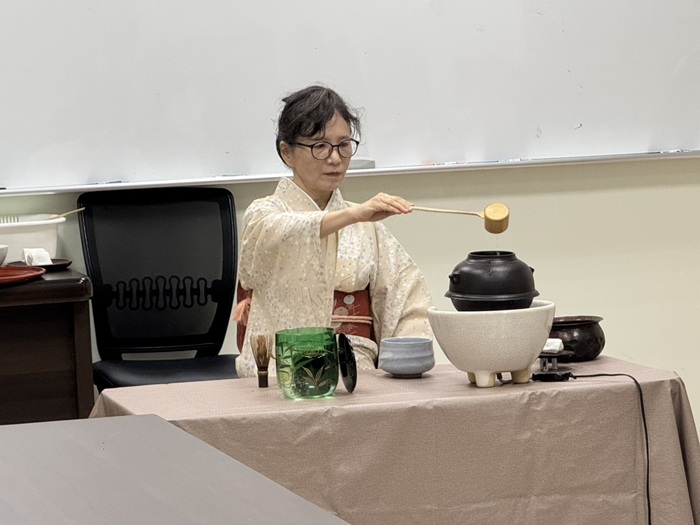
One of the highlights of the camp was the tea ceremony session, which featured a special demonstration of the Ryūrei-style tea ceremony by a professor from Japan’s Mushakoji Senke School of Tea Ceremony and Associate Professor Ya-Sui Cheng from the College of Management, Yuan Ze University. Through her meticulous demonstration, Cheng guided students in appreciating matcha and traditional Japanese sweets while explaining the principles of harmony, respect, purity, and tranquility embodied in the Japanese tea ceremony. The session enabled participants to understand the cultural values of mutual respect, harmony, and inner peace.
In addition, Japanese students served as camp assistants, introducing Japanese food culture in Japanese and guiding participants in making traditional Japanese sweets. Students also took part in a takoyaki-making experience. From ingredient preparation to the completion of the dish, participants experienced firsthand how one of Japan’s most popular household foods was made and gained further insight into everyday Japanese culinary culture.
The Department of Foreign Languages and Applied Linguistics stated that immersive and diversified learning approaches allowed language learning to extend beyond the classroom and become an important bridge to cultural understanding. The department will continue to promote distinctive programs that integrate language learning, cultural exploration, and hands-on experiences, providing graduate and undergraduate students with opportunities to apply what they have learned while serving the community. At the same time, these initiatives will help high school students broaden their international perspectives and strengthen their intercultural communication skills.